


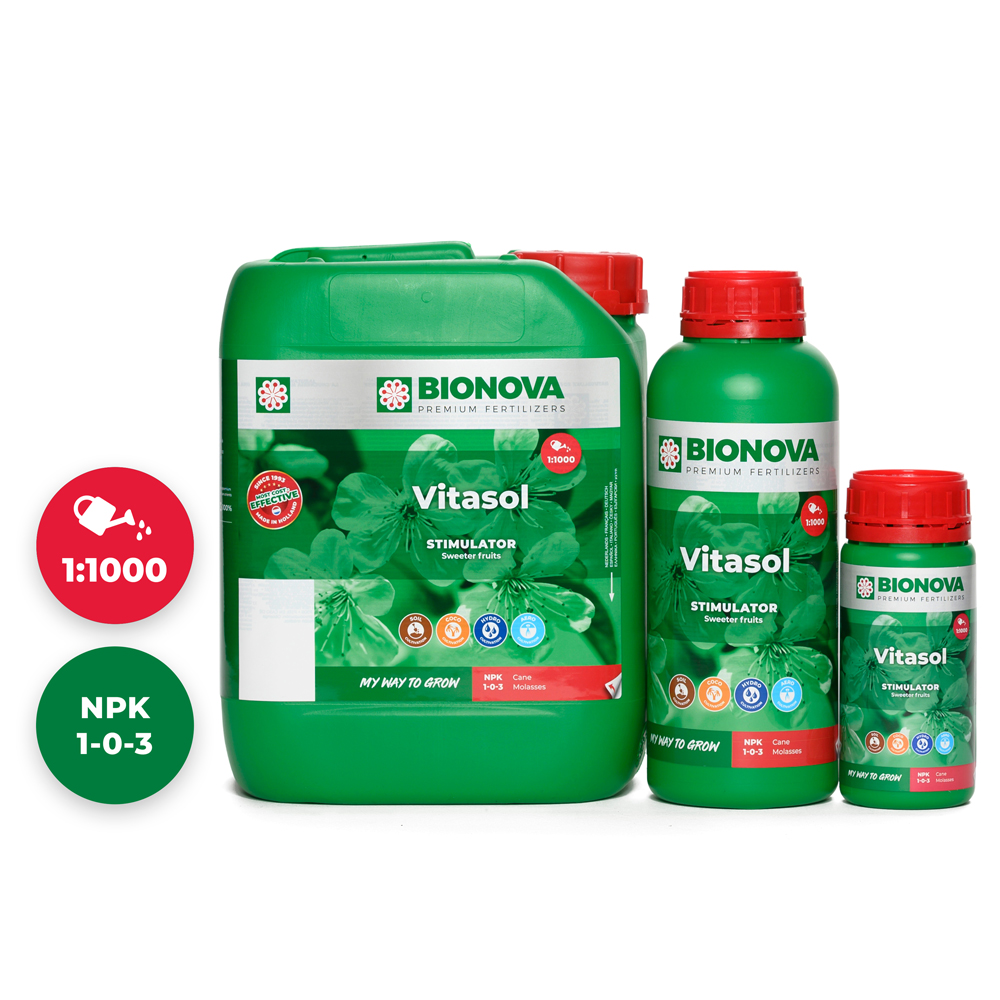
Vitasol
€19.95
Product information "Vitasol"
Vitasol
Natural sweetness!
WHY
Develops a sweeter taste in every harvest!
100% natural ingredients in Vitasol provide natural sweetness!
Vitasol offers a high capacity for absorbing sugars!
Using Vitasol gives every flower more energy!
What is Vitasol?
This fruit sweetener contains natural sugars, calcium, magnesium, copper, lime, potassium, vitamins and many vegan trace elements. Vitasol is excellent as a converter of available nutrients. Especially in periods of high production and fast growth (with artificially lit plants) or when growth stagnates due to nutrient deficiency, using Vitasol in these flowering phases provides more energy.
When should Vitasol be used?
Use Vitasol as a sweetener in the last weeks of the flowering phase at a dosage of 5-10 ml per 10 litres. Bionova Vitasol as a microorganism boost: 2.5-5 ml per 10 litres. Vitasol can be used in combination with all Bionova nutrients, stimulators, minerals, universal products and substrates.
How should Vitasol be used?
Application via watering
Shake well and add 4-10 ml per 10 litres every time you prepare your nutrient solution. Use this solution every time the plants are watered in the last weeks of flowering.
Tips from the growers!
Molasses helps feed the microbes already present in the substrate. But you can give your mix an extra punch by adding rhizobacteria as well. This type of bacteria does a lot of good by helping release nutrients and fight pathogens.
WHAT’S INSIDE?
Potassium:
1. Potassium regulates the opening and closing of stomata and thus the uptake of CO2, which improves photosynthesis.
2. It triggers the activation of important biochemical enzymes for the formation of adenosine triphosphate (ATP). ATP provides energy for other chemical and physiological processes such as the excretion of waste products in plants.
3. It plays a role in the osmoregulation of water and salts in plant tissues and cells.
4. Potassium also facilitates protein and starch synthesis in plants.
5. It activates enzymes responsible for specific functions.
Sugar cane molasses:
1. Sugar cane molasses stimulates and promotes fast plant growth and supplies the plant with iron, magnesium, potassium, sulphur and some trace elements. Molasses fertiliser protects plants against diseases, pests, heat stress and cold damage.
2. What does molasses do for the soil? Adding molasses to the soil has been shown to improve the bacterial health of the soil, making plants more receptive to nutrients and generally healthier.
Amino acids:
1. Proline protects plants against various stresses and also helps plants recover from stress faster.
2. Glycine, which is often used to make a wide range of amino-chelate fertilisers.
3. Hydroxyproline, which provides structural integrity for mediating cell-to-cell interactions and communication.
4. Alanine, a defence substance that enables plants to withstand various stresses such as hypoxia, waterlogging and drought, and indirectly a precursor of the compounds pantothenate and CoA.
5. Arginine, an important storage and transport form of organic nitrogen in plants.
6. Lysine, an important signalling amino acid that regulates plant growth and responses to the environment.
7. Glutamine, an effective nitrogen source for plant growth
Trace elements:
1. Boron, mainly involved in cell wall synthesis and structural integration.
2. Copper is needed for many enzymatic activities in plants and for chlorophyll and seed production.
3. Iron: many of the plant’s vital functions, such as enzyme and chlorophyll production, nitrogen fixation, development and metabolism, depend on iron.
4. Manganese, a metal that is an essential cofactor for the oxygen-evolving complex (OEC) of the photosynthesis machinery and catalyses the water-splitting reaction in photosystem II
5. Zinc helps the plant produce chlorophyll.
Organic/mineral combination
Fertiliser NPK 1-0-3
1% total nitrogen (N), that is:
1% organic nitrogen (N) of plant origin
3% potassium oxide (K2O), water-soluble
1.4% sulphur trioxide (SO3), water-soluble
0.06% manganese (Mn), water-soluble, EDTA chelate
Login