


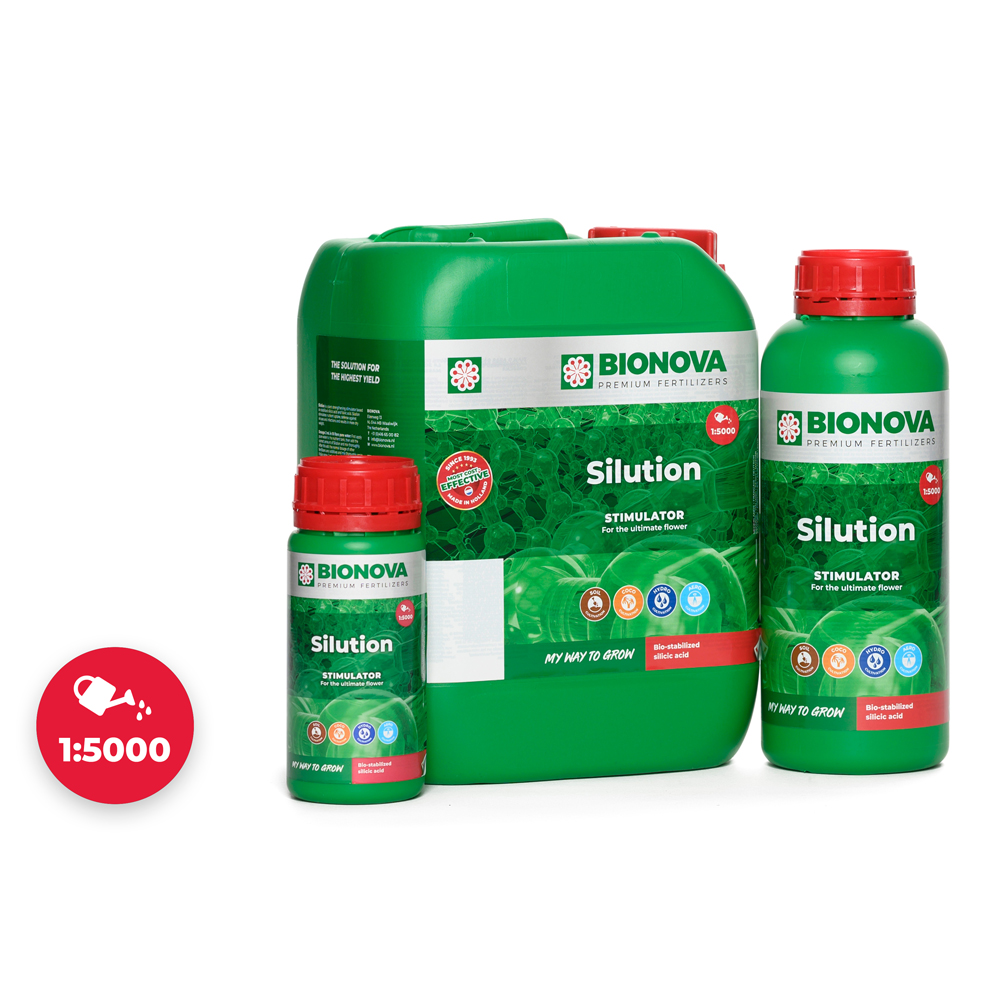
Silution
€165.00
Product information "Silution"
Silution
The solution for the highest yield!
WHY
The only bio-stabilised monosilicic acid, enriched with premium fulvic acid!
Bionova’s formula, patented worldwide!
Guaranteed monosilicic acid!
Bigger, denser flowers!
What is Silution?
The effectiveness of Silution in strengthening the plant and stimulating growth and flowering is especially visible for growers with less-than-optimal growing conditions, such as growing in warm climates and under conditions with a high risk of infection. Although silicon is found in the soil almost everywhere on earth, it is usually not available to plants. Most substrates contain no plant-available silicon. The monosilicic acid in Silution is the only form of silicon that is 100% bioavailable to the roots.
When should Silution be used?
Always put water in the tank first, then add the right amount of Silution and mix thoroughly! Then add the normal dosage of other nutrients and stimulants and mix thoroughly again! Silution can be used from the first week of growth until the last week of flowering.
Silution can be used in combination with all Bionova nutrients, stimulators, minerals, universal products and substrates.
Bionova Silution can be used for watering and as a foliar spray.
How do you use Silution?
Application via watering
First mix 2 ml thoroughly into 10 litres of water. Then add all other nutrients and stimulators.
Application as a foliar spray
Spray Silution from the start to the end of the growth phase to promote the number of internodes, which leads to a bigger harvest. Mix 2 ml per 1 litre of water.
WHAT’S INSIDE?
Silicon (Si) as (Si(OH)4):
1. It has been found to improve drought tolerance and delay wilting in certain crops where irrigation is withheld, and to improve the plant’s ability to withstand drought and metal toxicity.
2. Promotes the strengthening of cell walls and provides increased mechanical support to the above-ground parts of the plant.
Potassium:
1. Potassium regulates the opening and closing of stomata and thus the uptake of CO2, which improves photosynthesis.
2. It triggers the activation of important biochemical enzymes for the formation of adenosine triphosphate (ATP). ATP provides energy for other chemical and physiological processes such as the excretion of waste products in plants.
3. It plays a role in the osmoregulation of water and other salts in plant tissues and cells.
4. Potassium also facilitates protein and starch synthesis in plants.
5. It activates enzymes responsible for specific functions.
Fulvic acid:
1. Fulvic acid is one of the 3 humus components and is formed when plants are digested by microorganisms. It is a substance with many positive effects on plant and substrate health. For example, fulvic acid mobilises nutrients to and within plants.
2. Iron and magnesium ions are essential for photosynthesis, and fulvic acid promotes the transport of these ions from the soil into plant cells through a chelating effect, which activates photosynthesis.
3. In nature, fulvic acid plays an essential role in mobilising minerals and creating all kinds of compounds that help plants absorb nutrients.
Boron (B), zinc (Zn):
1. Boron is mainly involved in cell wall synthesis and structural integration. Boron plays a key role in a wide range of plant functions, including cell wall formation and stability, maintaining the structural and functional integrity of biological membranes, transporting sugar or energy into growing plant parts, and pollination and seed formation.
2. Zinc helps the plant produce chlorophyll. Zinc is an important component of various enzymes responsible for many metabolic reactions in all crops. Growth and development would stop if certain enzymes were not present in the plant tissue. Carbohydrate, protein and chlorophyll formation are significantly reduced in zinc-deficient plants.
EC FERTILISER
Mixture of the micronutrients boron and zinc.
Micronutrients in percentage by weight:
0.6% boron (B), water-soluble:
1.4% zinc (Zn), water-soluble, EDTA-chelated.
Also contains:
1.45% silicon dioxide (SiO2)
Login